Is IDD a Sunset Business? A Realistic Look at the Future of International Calling
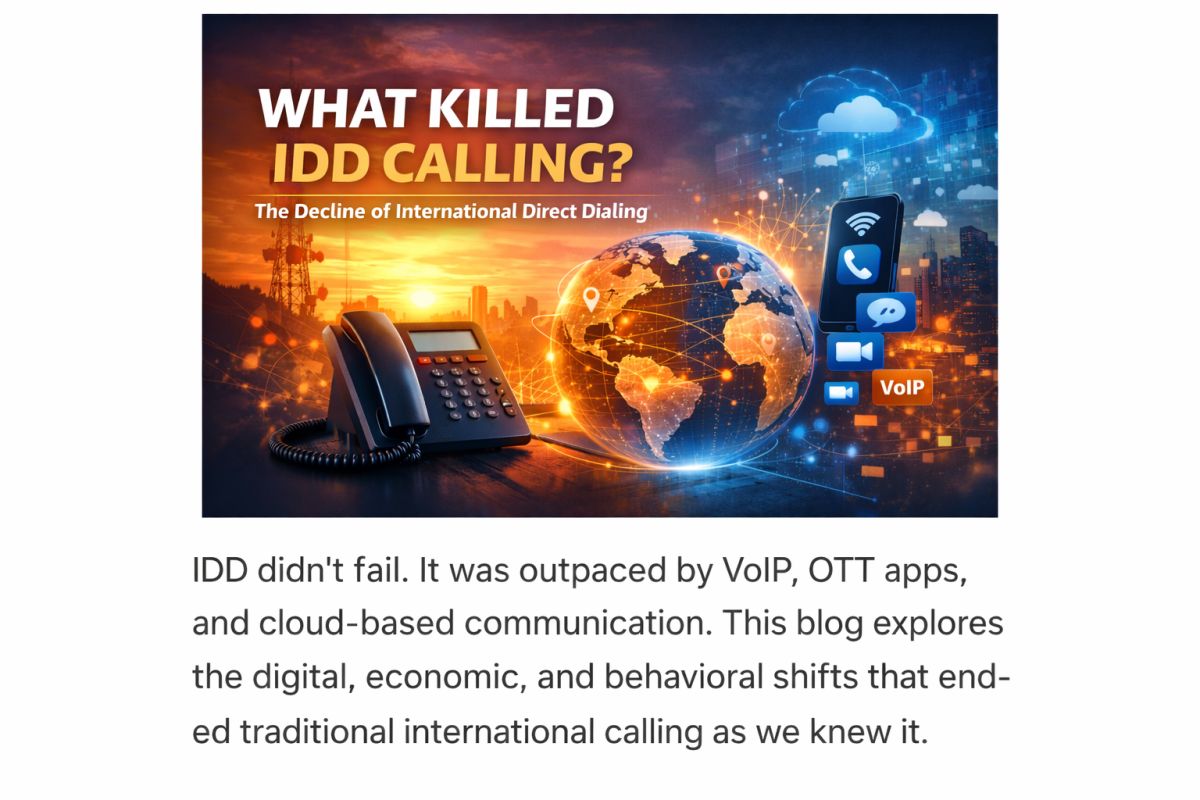
International Direct Dialing (IDD) is no longer the default for global communication. As businesses shift toward cloud voice, VoIP, and AI-driven calling, traditional IDD faces decline—but international voice itself is far from obsolete.

 |  |  |
For decades, International Direct Dialing (IDD) has been the backbone of cross-border voice communication. From multinational enterprises coordinating global teams to call centres handling overseas customers, IDD once represented reliability and reach.
But with the rapid rise of VoIP, cloud communications, and AI-driven voice platforms, a critical question emerges:
Is IDD becoming a sunset business?
The short answer: traditional IDD is declining — but international voice itself is not dead.
What’s Driving the Decline of Traditional IDD?
1. OTT Apps Have Changed Consumer Behaviour
Consumer usage has shifted heavily toward apps like WhatsApp, Zoom, and Teams. These platforms offer:
Near-zero marginal cost
Video + chat integration
Global reach without telco complexity
For personal calls, IDD is no longer the default choice.
2. Cost Structure Is No Longer Competitive
Traditional IDD relies on:
Per-minute billing
International carrier interconnect fees
Legacy switching infrastructure
In contrast, VoIP operates on packet-switched networks, dramatically reducing cost per call.
3. Enterprises Are Moving to Cloud Voice
Businesses increasingly prefer:
SIP trunks over PSTN lines
Cloud PBX instead of on-premise switches
API-based voice integration
As a result, standalone IDD usage is shrinking, especially for SMEs and tech-forward firms.
Why IDD Is Not Completely Dead
Despite the decline, calling IDD a “dead business” would be inaccurate.
1. Reliability Still Matters
IDD remains relevant where:
Internet connectivity is unstable
Low-latency, guaranteed call quality is required
Regulatory environments restrict OTT usage
Certain regions and industries still trust PSTN-based international calls more than internet-dependent solutions.
2. Enterprise & Government Use Cases Persist
Large enterprises, banks, healthcare providers, and government agencies often require:
Deterministic routing
Call traceability
Regulatory compliance
In these environments, IDD or hybrid voice routing remains part of the architecture.
3. Voice Is Evolving, Not Disappearing
The demand for international voice communication still exists — it’s simply delivered differently:
SIP-based international calling
Voice APIs embedded into CRMs
AI-powered voice agents handling cross-border calls
IDD traffic is declining, but international voice minutes are being re-packaged, not eliminated.
The Real Shift: From IDD to Intelligent Voice Services
The future is not “IDD vs no IDD”, but rather:
| Old Model | New Model |
|---|---|
| Per-minute IDD | Bundled voice services |
| PSTN-centric | SIP & cloud-based |
| Human-only calls | AI + human hybrid |
| Static routing | Smart, dynamic routing |
Companies that survive are those that evolve IDD into value-added voice solutions, such as:
Digital voice agents
Cloud contact centres
Global SIP connectivity
AI-driven call handling and analytics
So, Is IDD a Sunset Business?
Traditional IDD, as a standalone retail product — yes, it is sunset.
International voice communication — absolutely not.
The winners in this space are not selling “IDD minutes” anymore.
They are selling:
Availability
Reliability
Automation
Global reach, abstracted from complexity
Final Takeaway
IDD is not dying — it’s being absorbed into a larger, smarter voice ecosystem.
Businesses that continue to treat IDD as a legacy revenue stream will struggle.
Those that reposition it as part of a cloud-based, AI-enabled voice platform will remain highly relevant.