What Killed IDD Calling? The Forces Behind the Decline of International Direct Dialing
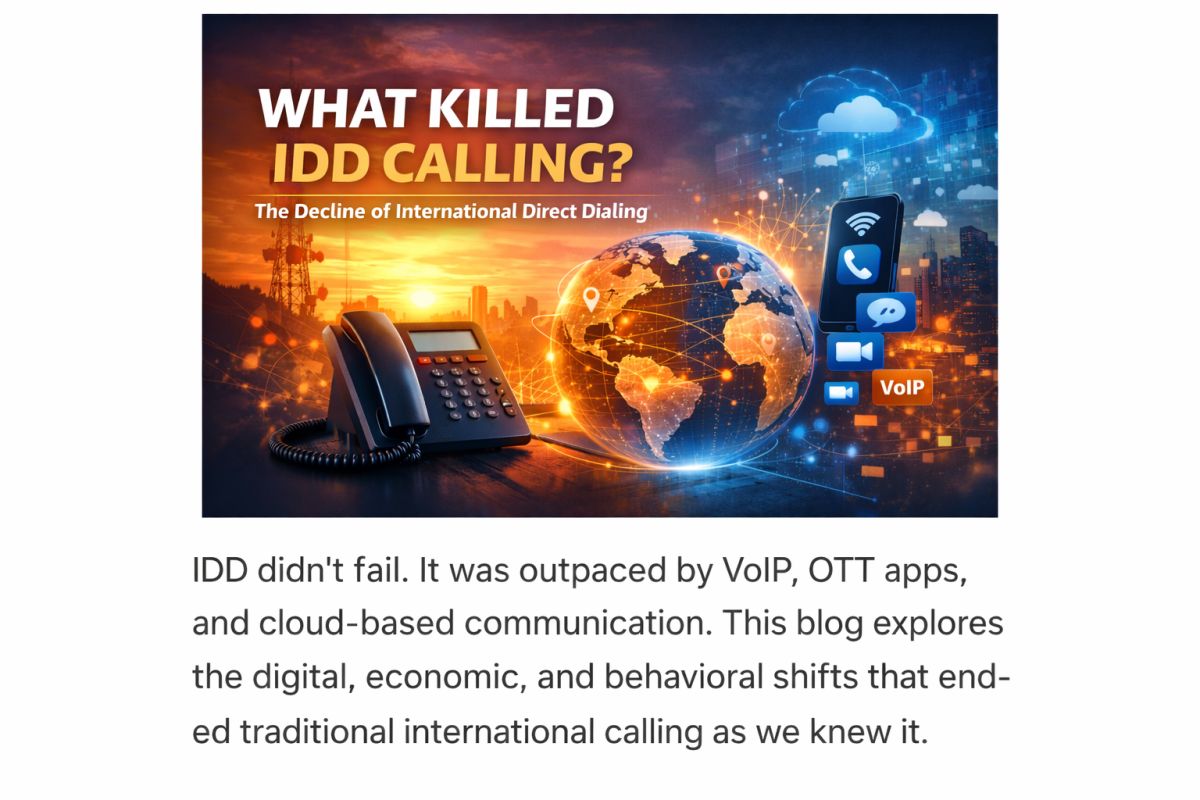
IDD calling didn’t fail—it was outpaced. VoIP, OTT apps, cloud communications, and changing cost expectations reshaped how the world makes international calls.
 |  |  |
For many years, International Direct Dialing (IDD) was the default way individuals and businesses communicated across borders. From multinational corporations to overseas customer support lines, IDD once symbolised global connectivity.
Today, however, IDD traffic is shrinking worldwide.
So what exactly killed IDD calling?
The answer isn’t a single technology, but a convergence of digital, economic, and behavioural shifts that fundamentally changed how the world communicates.
1. The Rise of Internet-Based Calling (VoIP)
The most significant disruptor of IDD is Voice over Internet Protocol (VoIP).
VoIP allows voice calls to be transmitted over the internet rather than traditional circuit-switched networks. This immediately changed the economics of international calling by:
- Eliminating per-minute international termination fees
- Enabling flat-rate or bundled pricing
- Making cross-border calls almost free at scale
As broadband and mobile data became ubiquitous, VoIP removed the cost advantage IDD once had.
2. Over-the-Top (OTT) Communication Apps
Consumer behaviour shifted rapidly with the rise of OTT platforms such as:
- Messaging apps
- Video conferencing tools
- Integrated collaboration platforms
These services offer voice, video, and chat in a single interface, often at zero incremental cost.
For personal use and even many business scenarios, IDD became unnecessary when users could simply tap a contact and call globally over data.
3. Cloud Communications and SIP Trunking
Enterprises moved away from legacy PBX systems toward:
- Cloud PBX
- SIP trunks
- API-driven voice platforms
This transition replaced traditional IDD routing with IP-based international voice, allowing companies to:
- Dynamically route calls
- Integrate voice with CRM systems
- Scale globally without local telco contracts
As a result, IDD was displaced inside corporate environments, not just consumer markets.
4. Changing Cost Expectations
IDD pricing models were built on:
- Per-minute billing
- Complex international rate cards
- Time-of-day pricing
Modern users expect:
- Flat or predictable pricing
- Unlimited or bundled usage
- Transparent billing
When pricing expectations changed, IDD felt outdated and expensive, even when actual call quality remained high.
5. Mobile Data Became Cheaper Than Voice
The rapid drop in mobile data costs globally was another silent killer of IDD.
With affordable:
- 4G and 5G networks
- Global roaming data packages
- Wi-Fi availability
Data-based calling became more accessible than traditional voice, making IDD a secondary or fallback option rather than the primary choice.
6. Decline of Consumer PSTN Usage
IDD is tightly coupled with the Public Switched Telephone Network (PSTN).
As consumers:
- Abandoned landlines
- Reduced reliance on traditional voice plans
- Shifted to mobile-first communication
The infrastructure and usage patterns that supported IDD naturally declined with it.
7. Voice Is No Longer the Only Channel
Modern communication is multimodal:
- Voice
- Video
- Chat
- Asynchronous messaging
IDD supports only one channel—voice—while modern platforms provide richer interaction. This made IDD less relevant in a world where communication is contextual and collaborative.
What Didn’t Kill IDD
It’s important to clarify what did not kill IDD:
- Call quality
- Global reach
- Network reliability
In many cases, traditional IDD still delivers excellent call clarity and stability. The decline was driven by economics and user behaviour, not technical failure.
Is IDD Truly Dead?
Not entirely.
IDD still exists in:
- Regulated industries
- Regions with limited internet access
- Backup and failover voice routing
- Certain government and enterprise use cases
However, its role has shifted from primary communication method to supporting or fallback infrastructure.
The Bigger Picture: IDD Didn’t Die — It Was Replaced
IDD wasn’t destroyed by a single innovation.
It was outpaced.
Replaced by systems that were:
- Cheaper
- More flexible
- More integrated
- Better aligned with modern workflows
International calling didn’t disappear.
Only the way it’s delivered changed.
Final Thoughts
IDD calling didn’t fail—it became obsolete in its original form.
The companies that survived this shift didn’t defend IDD minutes.
They reinvented international voice through cloud, software, and automation.
In today’s market, the future belongs not to IDD as a product, but to intelligent global voice services built on modern infrastructure.